Artificial intelligence is changing how you work, learn, and solve problems. You have probably come across chatbots, virtual assistants, and automation tools. One term now stands out from the rest: AI agents.
If you find yourself asking, what is an AI agent, and why is everyone from students to professionals talking about it, you are in the right place. At WebVeda, we built this guide to break the concept down in plain language.
By the end, you will understand how these tools work and how to start using them in your own career or studies.
What Is an AI Agent, Exactly?
To answer what is an AI agent in simple terms, think of it as a software program that can interpret a goal, decide what steps to take, and act on your behalf to complete a task. Unlike a basic chatbot, an AI agent can plan steps, use tools, and follow through until the job is done.
This is often called agentic AI. Instead of waiting for each instruction, the agent understands your goal and figures out how to reach it, whether that means checking a calendar, sending an email, or writing code.
Some AI agents rely on large language models to reason through problems. Others combine smaller programs, each handling one part of a task. Either way, the result behaves less like a tool and more like an initiative-taking assistant.
How Does an AI Agent Work?
Most AI agents follow a cycle: perceive, reason, act, and learn.
First, the agent gathers information, such as your prompt, a document, or live data from an app. Next, it reasons through that information using machine learning models to decide what action makes sense.
Then it acts, drafting a reply, booking a meeting, or pulling numbers from a spreadsheet. Some agents can use feedback or stored information to improve how they handle future tasks.
This ability to adapt to context distinguishes many AI agents from traditional automation, where a system typically follows predefined rules.
If this sounds like a skill worth having, our AI for Beginners course walks you through these ideas at a comfortable pace, even if you have never touched a line of code.
Types of AI Agents You Should Know
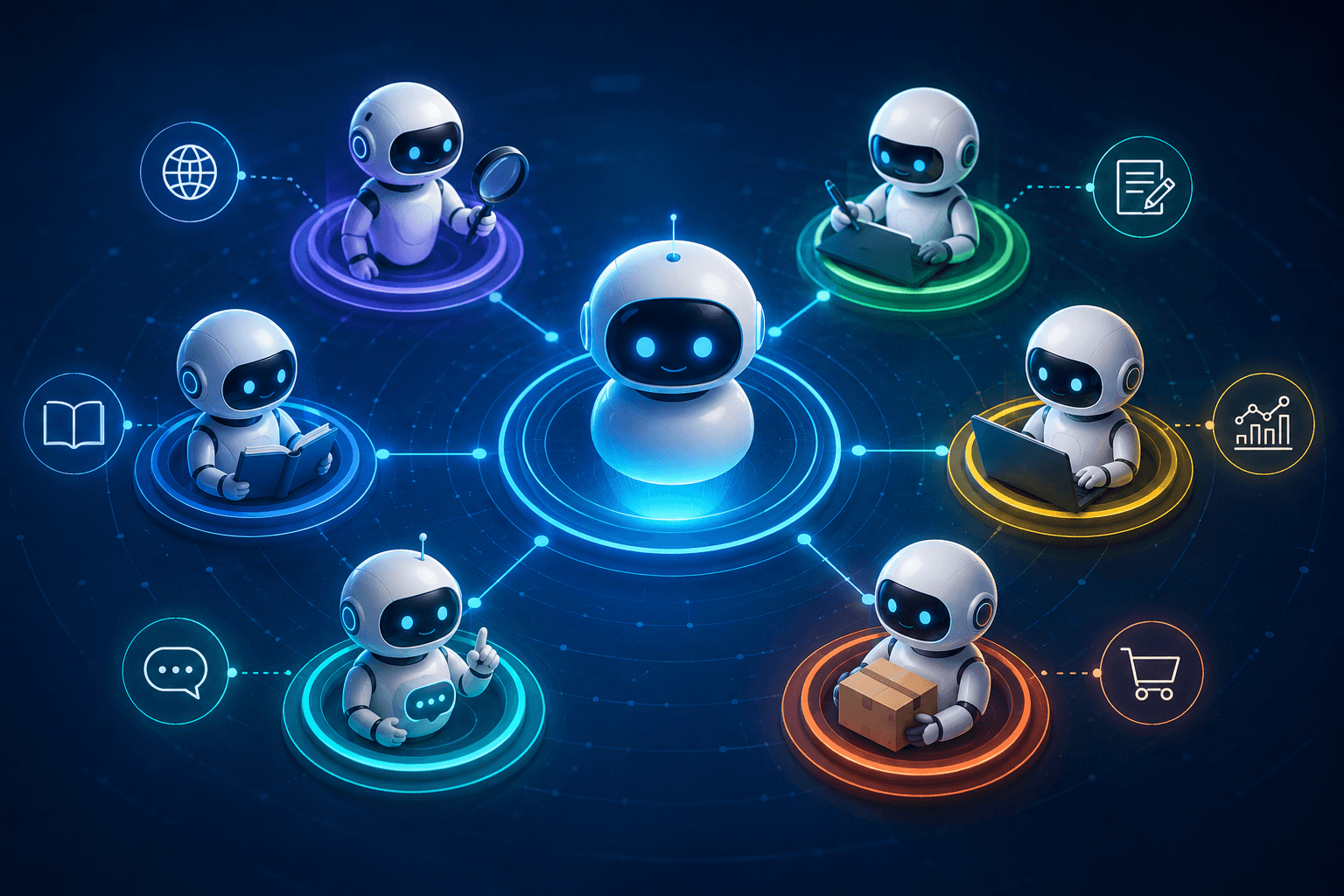
Not every AI agent works the same way. Common ways to classify AI agents include:
Reactive agents: Respond to specific inputs without storing past information.
Goal-based agents: Work backward from an outcome, choosing actions that move closer to it.
Learning agents: Improve their performance over time by analyzing results.
Multi-agent systems: Several agents work together, each handling a different part of a task.
Understanding these helps you pick the right tool for the job.
Real-World Examples of AI Agents You Already Use
AI agents are not a distant concept. Some customer service systems can function as AI agents when they can interpret requests, access relevant tools, and take actions without requiring a human for every step. Scheduling assistants that find a meeting slot across calendars are AI agents too, as are recommendation systems that adjust suggestions based on your activity.
In the workplace, AI agents now handle research summaries, draft outreach messages, and organize data from several sources. Knowing how to prompt these systems is a practical career skill. Our AI Prompts for Career Growth course shows you how to get sharper output from the AI tools you already use.
AI Agent vs Chatbot: What Is the Difference?
A chatbot answers questions. An AI agent completes tasks.
A conversational AI chatbot works within a single exchange. You ask something, it replies, and the interaction ends there. An AI agent carries out multi-step actions across tools and time, checking its own progress until the goal is met.
Think of a chatbot as a search box and an AI agent as a coworker who finishes the assignment.
Why Understanding AI Agents Matters for Your Career
Employers are adopting AI agents to handle repetitive work, freeing people to focus on higher-value tasks. Knowing how these systems function makes you more valuable in almost any role.
Students benefit early too, since many recruiters now expect basic AI fluency. Our AI for Students course covers use cases suited to coursework and internships. Job seekers can also explore our AI job search system, which uses agent-style tools to speed up applications.
How to Start Building Your Own AI Agent
You do not need years of coding experience to get started. If you want to build AI agents with code, learning Python is a useful starting point because it is widely used in AI and agent development frameworks. Our Python Essentials for Beginners course covers the foundation you need.
From there, you can connect your agent to real tools and APIs, give it memory, and deploy it to work independently. Our Build Your AI Agent course walks you through this process, from your first API call to a deployed AI assistant for your portfolio.
Frequently Asked Questions
What is an AI agent in the simplest terms?
An AI agent is a program that can understand a goal, plan the steps needed, and take action on its own, rather than just responding to a command.
Do I need to know how to code to build an AI agent?
Basic coding knowledge helps, especially with Python, but many beginner-friendly courses guide you through the fundamentals step by step.
How is an AI agent different from a regular chatbot?
A chatbot typically answers one question at a time, while an AI agent can complete multi-step tasks and follow through until the goal is achieved.
Are AI agents safe to use for everyday tasks?
When set up thoughtfully and monitored appropriately, AI agents can be a reliable part of your workflow, though it helps to review their actions regularly.
Can a complete beginner learn to build an AI agent?
Yes, with well-structured guidance, beginners can learn the core concepts and build a working AI agent without prior technical experience.
Final Thoughts
Now you have a clear answer to what is an AI agent and why this skill matters. AI agents are already changing how people study, work, and solve problems. The best way to understand them is through practice. Explore our course library to build practical knowledge and develop a portfolio-ready AI skill.
Recent Blogs

Career Growth
Learn how to recover from burnout without quitting, and fix the causes.
Read more


Freelancing
GST for freelancers in India explained: and mistakes to avoid.
Read more

Career Growth
Learn how to write a career break resume: list the gap honestly, and more.
Read more

Career Growth
Learn how to switch careers with no experience: test a new field.
Read more